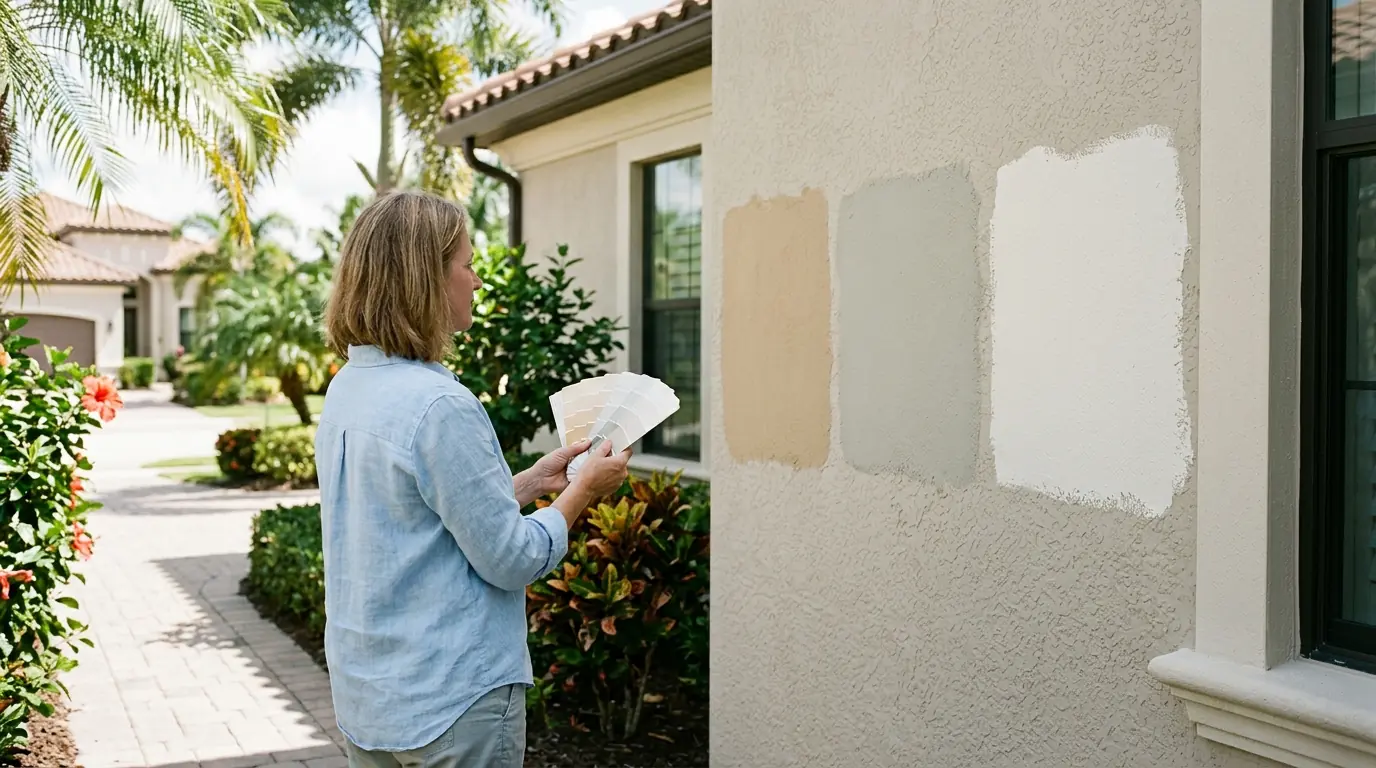
Start by reading your community's guidelines and approved palette, if one exists. Send in color names, codes and where each goes (body, trim, door, accents), plus photos of the house and large samples. Allow time for the committee's meeting cycle, and do not start painting until written approval arrives.
Why so many Sarasota homes need approval
Deed-restricted communities are common across Sarasota and Manatee counties, from gated neighborhoods built around golf courses to newer master-planned areas and condominium associations. Most of them have covenants that control how the exterior of each home looks, and paint color is almost always on the list. The intent is a consistent look along the street. In practice, it means a homeowner who repaints without approval can receive a violation notice and, in some cases, be asked to repaint again at their own expense.
Even a repaint in the same color may need some kind of approval or at least notice, depending on the community's documents. Rules vary widely. Some boards only care about the body color, while others review trim, front doors, garage doors, shutters and even roof colors. Some communities have a fixed palette to choose from; others review each request on its merits. The first job is simply finding out what your own documents say, because assumptions based on a friend's neighborhood often turn out to be wrong.
Read the guidelines before choosing colors
Your association's architectural guidelines are usually available from the management company or on the community's resident portal. Look for a section on exterior paint, and note whether there is an approved color palette or a list of preset schemes. If there is a palette, choosing from it is by far the fastest path to approval. If you want something outside it, expect more scrutiny and possibly a request to see the color on the house before the committee decides.
Pay attention to the details as well as the colors. Some communities require that neighboring homes not share the same scheme, so a house next door painted last year may knock your favorite option off the list. Others limit how many colors can be used, or require trim to be a particular white. A few restrict sheen on certain surfaces. Learning these rules up front saves you from falling in love with a palette the committee will not accept.
- Is there a fixed palette or preset color schemes
- Which surfaces need approval: body, trim, doors, shutters
- Any rule against matching the house next door
- Required trim color or sheen limits
- How often the architectural committee meets
What a strong application includes
Committees respond best to applications that make their job easy. That means clear color information: the manufacturer's color name and code for each surface, listed by where it goes. A simple chart that says body, trim, front door, garage door and accents, with the color beside each, avoids confusion. Include current photos of the front and sides of the house, and note any parts staying the same, such as a roof or pavers. If the application asks for contractor details, include those as well.
Visuals help even more. Physical color samples, or photos of large test patches painted directly on the house, give the board a realistic sense of the result. Some homeowners also show photos of other approved homes in the community with similar schemes, which can reassure a hesitant committee. The goal is to leave no room for guesswork. A thin application with a few color names scribbled on a page invites follow-up questions, and each round of questions can add another meeting cycle to the timeline.
- Color name and code for each surface
- Current photos of every visible side of the house
- Photos of large samples painted on the walls
- A note on fixed elements like roof and pavers
- Contractor details if the application asks for them

Timing the approval with the paint schedule
Architectural committees often meet monthly, and some meet less often in the summer when many seasonal residents are away. Missing a submission deadline by a day can push your review back several weeks. Ask the management company for the meeting calendar and the cutoff date for each meeting before you plan anything else. Once you know when a decision is likely, you can line up your preferred painting window with a realistic margin rather than a hopeful guess.
We generally suggest getting written approval in hand before locking in start dates. Scheduling the crew first and hoping the approval arrives in time often leads to rescheduling, and in the busy winter season, a lost slot can mean waiting a while for another. While you wait for the committee, other parts of the job can move forward: a walk-through, repair planning, trimming back plants and deciding on sheen. That way, once approval comes through, the job can start without delays.
If the committee says no
A denial is not the end of the road. Read the decision carefully, since committees often explain what they object to. It may be a single element, perhaps a front door color that is too bright, or a body that sits too close to a neighbor's. Adjusting one part and applying again is usually faster than starting from scratch. A polite call to the management company to understand the concern can save a second rejection and gives you a clearer sense of what the board will accept.
If you feel strongly about a color, ask whether you can attend the meeting or bring additional samples. Committees are made up of neighbors, and many are open to a reasonable case, especially when it is backed by photos of the color in real light on your actual walls. That said, the safest move for most homeowners is a scheme that sits comfortably inside the community's palette, with personality expressed through the front door or landscaping rather than the main body.
How our painters help with the paperwork
We cannot apply for approval on your behalf, since the application must come from the owner, but we can make the process easier. During the walk-through, we can brush large sample patches on the house so you can photograph them for the committee. We can help you list each surface and its color clearly. If the association asks for details from the painting contractor, we provide what is requested. Many of our exterior jobs in Sarasota involve an HOA, so the process is familiar territory.
We also make sure the colors that go on the house are exactly the ones that were approved. That sounds obvious, but mix-ups happen when a homeowner changes their mind late or when a similar color name gets confused at the store. Keep a copy of the approval letter handy and share it with the foreman on day one. If you are starting to plan an exterior repaint inside an HOA, give us a call and we will set up a visit and help you prepare.
- Large sample patches for committee photos
- A clear list of colors by surface
- Contractor details if the association asks
- A match check against the approval letter on day one