Moisture readings first
We check suspect walls with a moisture meter before coating, because sealing a damp wall behind a low-permeability film is how blisters start. Wet areas get traced to their source and allowed to dry out.
Hairline cracks keep reopening in your stucco every summer, and ordinary paint splits right along with them, letting wind-driven rain soak into the block behind it.
An elastomeric coating is a thick, rubbery acrylic film applied over stucco or block at several times the build of normal paint. On a Sarasota home we clean, patch and prime the walls first, then roll and back-brush the coating so it stretches across small cracks and sheds driving summer rain.
Standard exterior acrylic goes on a few mils thick and does a fine job on sound stucco. Elastomeric is a different product with a different job. It dries to a film many times thicker, and it can stretch and recover as the wall expands in afternoon heat and contracts after a cool storm. That flexibility lets it ride over the fine cracks that open and close on a block-and-stucco house, keeping water out of the wall instead of breaking along every line.
It is not the right answer for every wall, and we will tell you so. Elastomeric breathes less than regular paint, so it must go over dry, clean stucco with active leaks fixed first, or it can trap moisture and blister. It also cures to a slightly softer surface that holds dirt longer on shaded walls. When the stucco keeps cracking, the house takes rain hard from one direction, or the old paint is failing in patches, it is often the best long-term coating we can put on a Sarasota home.
We check suspect walls with a moisture meter before coating, because sealing a damp wall behind a low-permeability film is how blisters start. Wet areas get traced to their source and allowed to dry out.
Cracks wider than a hairline are opened slightly, filled with an elastomeric patching compound and textured to match, so the coating rides over a sound repair rather than trying to bridge an open gap.
Most older Florida stucco is chalky from years of sun. A masonry primer that locks down that chalk gives the elastomeric something solid to grip, which is the difference between a lasting film and one that peels in sheets.
The coating goes on thick, usually in two coats, at the spread rate the manufacturer specifies. We roll it and back-brush it into the texture so the film thickness is real, not stretched thin to save material.
Windows, doors, light fixtures and the pool cage frame are masked before coating starts. Elastomeric is hard to clean off glass and anodized aluminum once it cures, so our masking is thorough and tight.
Elastomeric is meant for masonry. Wood trim, fascia and doors get a compatible acrylic enamel instead, since a heavy rubbery film on wood can hold moisture against the boards and slow drying.
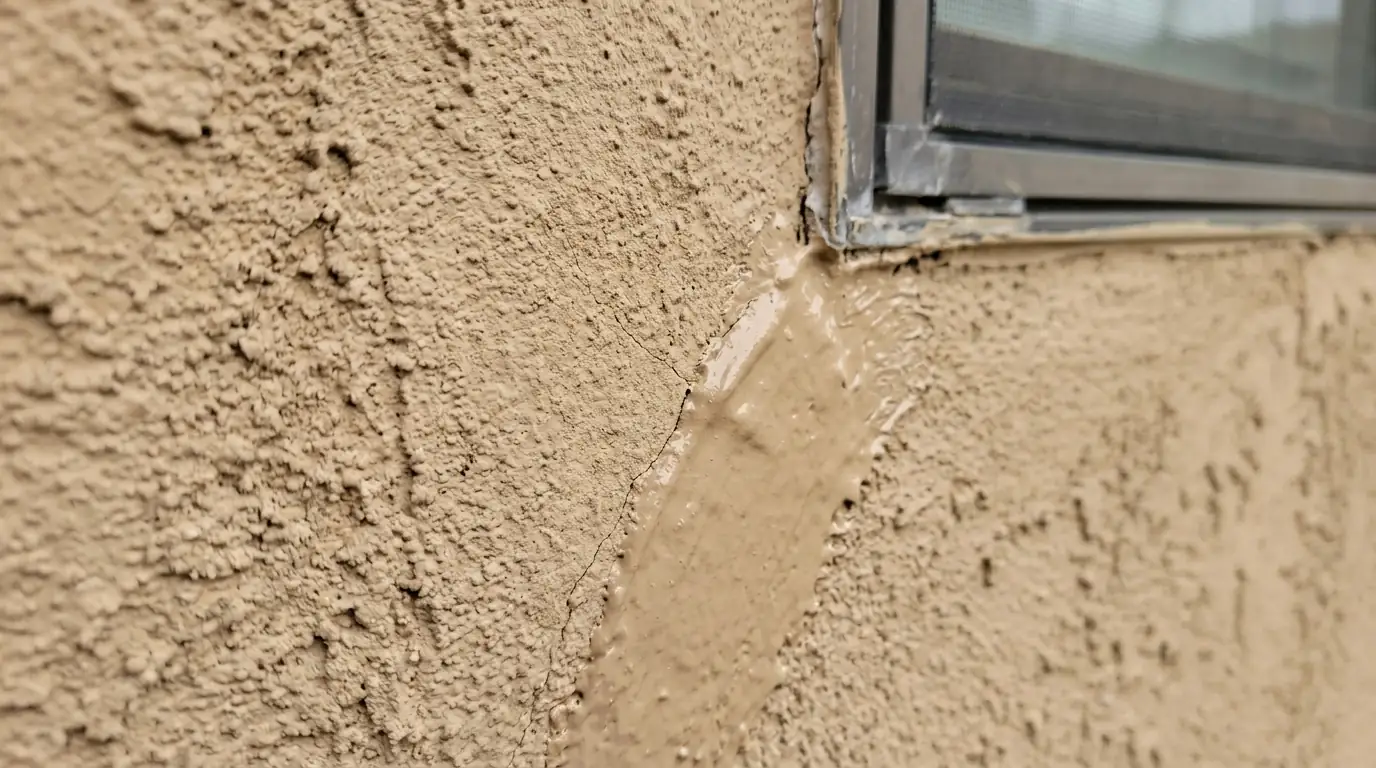
Most homes in Sarasota County are concrete block with a cement stucco skin. Block and stucco move at slightly different rates when a west wall bakes in the afternoon sun and then gets hit by a cool downpour an hour later, which happens almost daily from June through September. Over years, that cycling opens fine cracks around window corners, along block coursing lines and where additions meet the original house. Plain paint is too stiff to follow the movement, so it cracks with the stucco and wicks rain straight in.
Wind-driven rain is the other half of the problem. Hurricane season storms and summer squalls push water sideways into walls for hours, and homes on the barrier islands and the bayfront see the worst of it, along with salt carried in off the Gulf. Elastomeric's thicker film resists that pressure better than conventional paint. We take extra care with Sarasota School of Architecture homes and 1920s Mediterranean Revival houses, where original stucco may be softer, and we test adhesion on a small area before committing a whole wall.
We soft-wash the walls to remove mildew, dirt and loose chalk, then give the stucco at least a full dry day, longer after heavy rain, before any coating touches it. Moisture readings confirm it is ready.
Cracks are filled with elastomeric patch, gaps at windows and penetrations get a high-movement sealant, and repairs are feathered into the existing texture so they disappear under the coating.
A masonry primer or conditioner goes on over bare patches and chalky areas. It binds the surface and evens out absorption so the elastomeric dries to a consistent sheen and color across each wall.
We apply the elastomeric in two coats, rolling and back-brushing into the stucco texture. The second coat follows once the first has cured enough, which is often the next day in humid weather.
Before masking comes off, we walk each wall with you, check corners and edges where film tends to run thin, and touch up anything that needs it while the crew and ladders are still on site.
We price elastomeric coatings after seeing the job, and the written quote lists every item below that applies.
Call the office any hour and we will set a walk-through time.
It stops water coming through fine cracks and porous stucco, which is the most common path. It will not fix a leaking window frame, failed flashing where the roof meets the wall or a plumbing leak inside the wall. We look for those during the walk-through, and if the water source is something other than the stucco, we tell you before you spend money on coating.
Usually, yes, if the existing paint is still firmly attached. We wash it, test adhesion with tape in a few spots and prime any chalky or bare areas. Where old paint is peeling in sheets, it has to come off first, because a heavy elastomeric film pulling on weak paint underneath can lift it right off the wall.
It softens fine textures slightly because the film is thick. Heavy knockdown and sand-finish stucco keep their character well. A smooth or very fine float finish will look a little fuller after two coats. If texture matters, say on a mid-century house with crisp smooth walls, we can coat a sample section so you can judge it before we go further.
Stucco holds water longer than people expect. After a typical summer downpour we usually wait at least a full sunny day, and longer for shaded north walls or after several days of storms. We use a moisture meter rather than guessing. Rain forecast within a few hours of application also pushes the work back, since fresh elastomeric can wash before it sets.
Stucco walls washed, cracks repaired, patches primed and coated in breathable acrylic or crack-bridging elastomeric suited to Sarasota sun and rain.
Read moreCracks at window corners, block joints and additions are opened, filled with flexible patch and texture-matched so repairs disappear under fresh exterior paint.
Read moreFull exterior repaints with pressure washing, crack and wood repair, primers matched to each surface and two coats of acrylic made for sun and salt air.
Read moreElastomeric Coatings is available across our whole service area, including: